

Rare fragrance ingredients like Boronia absolute and Blue Cypress create complex, evolving scent profiles, while common ones like Rose and Vanilla offer familiar, straightforward aromas. Rare ingredients are labor-intensive to produce, exclusive to specific regions, and often cost significantly more - up to $100,000 per kilogram. Common ingredients, on the other hand, benefit from global cultivation and established supply chains, making them more accessible and affordable.
Key Highlights:
- Boronia vs Rose: Boronia offers fruity, woody complexity but requires 12.5M flowers for 1 kg of absolute. Rose is globally cultivated and features sweet, velvety floral notes.
- Blue Cypress vs Vanilla: Blue Cypress provides smoky, woody nuances with a rare cobalt-blue color, while Vanilla offers creamy sweetness, sourced from tropical regions.
- Wattleseed vs Sandalwood: Wattleseed adds earthy, nutty tones, while Sandalwood delivers a creamy, woody aroma but takes over 50 years to mature.
Quick Comparison Table:
| Feature | Rare Ingredients (e.g., Boronia, Blue Cypress) | Common Ingredients (e.g., Rose, Vanilla) |
|---|---|---|
| Scent Profile | Complex, evolving | Familiar, straightforward |
| Harvest Window | Short (2–4 weeks) | Longer, predictable |
| Cost per KG | High ($10,000–$100,000+) | Lower (varies by type) |
| Geographic Sourcing | Localized (e.g., Australia) | Global |
| Processing Methods | Labor-intensive | Standardized |
Rare ingredients bring exclusivity and depth to luxury fragrances, while common ones provide consistency and affordability. Both play crucial roles in shaping the artistry and accessibility of perfumery.
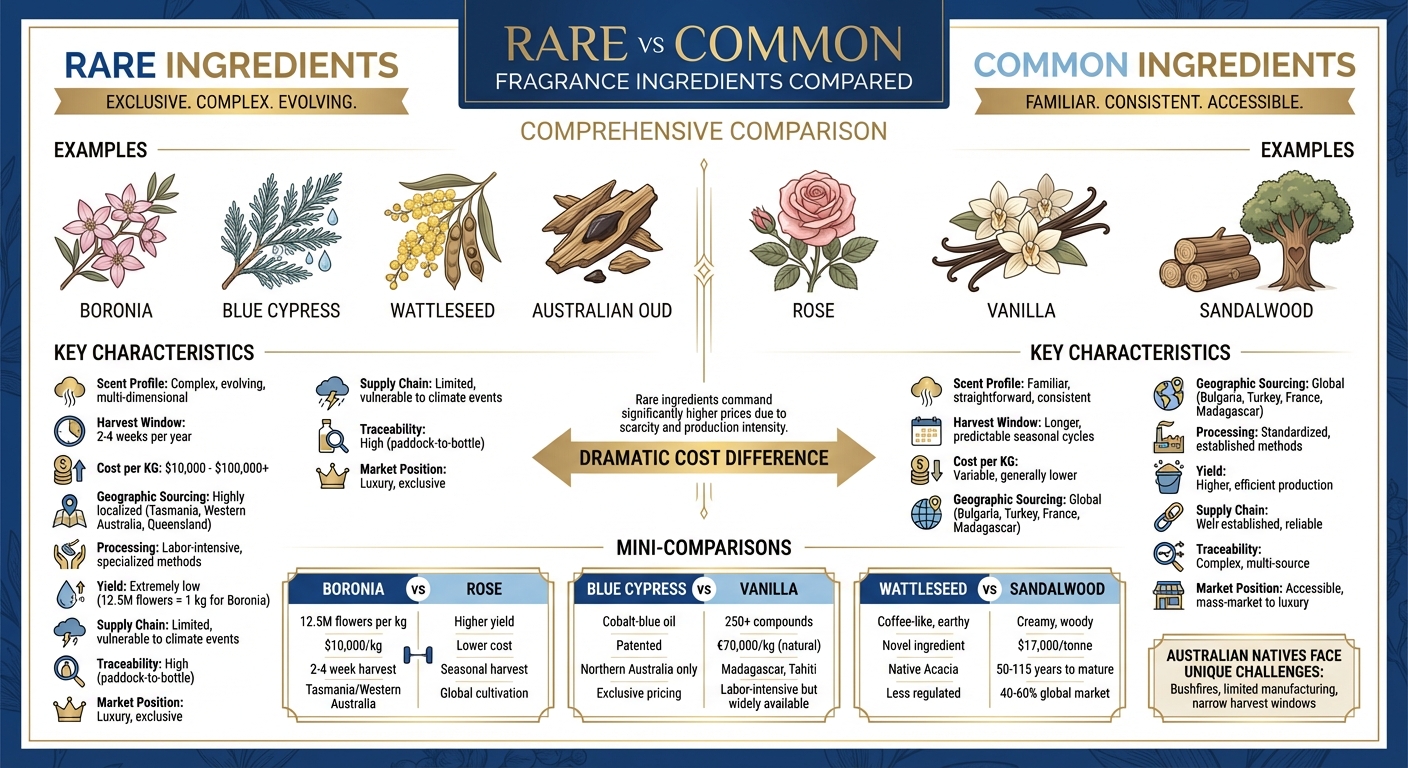
Rare vs Common Fragrance Ingredients: Cost, Sourcing, and Scent Profile Comparison
Boronia vs Rose: Rare vs Common Floral Notes
Boronia and Rose highlight two very different worlds in perfumery. Rose, with its timeless, sweet floral scent, is a cornerstone of many classic fragrances. Boronia, on the other hand, offers a layered and evolving scent journey, shifting from fruity to woody as it interacts with the skin. These differences also reflect the unique challenges in sourcing each flower.
Scent Characteristics
Rose is known for its consistent floral sweetness, often described as honey-like or velvety. In contrast, Boronia's scent unfolds like a story. Perfumer Mandy Aftel captures its essence perfectly:
as close to heaven as we are likely to get... reminiscent of raspberry, apricot, violet and yellow freesia
Boronia opens with fruity and floral notes, then transitions into earthy tones like tea, hay, and moss, before settling into warm, woody undertones. This complexity comes from its unique chemistry. Boronia contains a high concentration of beta-ionone, the molecule responsible for its violet and raspberry-like qualities. Interestingly, during a critical 48-hour "composting phase" post-harvest, natural enzymes in the flowers double the beta-ionone content, deepening its scent profile.
This depth and evolution set Boronia apart from the more straightforward, though no less beautiful, character of Rose.
Sourcing and Harvesting
The challenges of sourcing these florals couldn't be more different. Rose enjoys widespread cultivation in regions like Bulgaria, Turkey, France, and Morocco, with well-established harvesting practices. Boronia, however, is far more elusive. It thrives almost exclusively in Tasmania and Western Australia, with a fleeting harvest season of just 2 to 4 weeks in early September.
Boronia's cultivation is tricky. It’s highly sensitive to excess moisture - often referred to as "wet feet" - and requires specific temperatures around 68°F during processing. These factors make Boronia one of the most demanding and exclusive florals in the world of perfumery.
Comparison Table: Boronia vs Rose
| Feature | Boronia | Rose |
|---|---|---|
| Scent Profile | Complex: fruity (raspberry/apricot), floral (violet), earthy (tea/hay), woody | Classic, sweet, honeyed, velvety floral |
| Harvest Window | 2–4 weeks in early September | Longer seasonal harvests (spring/summer) |
| Yield | 12.5 million flowers per kilogram of absolute | Higher yield per acre |
| Geographic Source | Tasmania and Western Australia | Global (Bulgaria, Turkey, France, Morocco) |
| Processing Time | 3–4 days including composting phase | Standard extraction (under an hour) |
| Cost | Approximately $10,000 per kilogram | More accessible pricing |
| Perfumery Use | Adds depth to chypre and fougère creations | Primary heart note in floral fragrances |
Blue Cypress vs Vanilla: Contrasting Woody and Sweet Notes
Blue Cypress and Vanilla are two fragrance ingredients that couldn’t be more different. Vanilla is all about familiar sweetness, while Blue Cypress brings a smoky, woody character that's far more distinctive. These differences extend beyond their aromas to how they’re produced and used in perfumes.
Aromas and Extraction Methods
Natural vanilla is a complex aroma powerhouse, with over 250 aromatic compounds contributing to its creamy, leathery, and slightly smoky scent. This complexity is something synthetic vanillin - made from a single molecule - just can’t replicate. The production process for natural vanilla is incredibly meticulous. Vanilla orchid flowers bloom for just one day, requiring hand-pollination within a narrow 12-hour window. Once harvested, the beans go through a multi-stage curing process that includes immersion in hot water, sweating, drying, and conditioning.
On the other hand, Blue Cypress is extracted through steam distillation from the bark and wood of Australian pine trees. What makes it stand out - besides its smoky, spicy, and honey-like aroma - is its striking cobalt-blue color. This unique hue forms during distillation when the oils from the heartwood and sapwood react with the bark. The contrasting extraction methods highlight the uniqueness of each ingredient, setting them apart in the world of perfumery.
Supply and Perfumery Uses
Vanilla is cultivated in tropical regions like Madagascar, Tahiti, and the Comoros Islands. However, producing it is no easy feat - it takes around 1,000 hand-pollinated flowers to yield just one kilogram of cured vanilla beans. Despite this labor-intensive process, natural vanilla is widely available, though it comes at a steep cost. For instance, its CO₂ extract can reach prices as high as €70,000 per kilogram, while synthetic ethylvanillin costs a mere €12 per kilogram.
Blue Cypress, in contrast, is native to Northern Australia and is protected under Patent No. 742711, which governs both its extraction method and the oil itself. While the trees can live for over 200 years, the plantations are limited, making Blue Cypress a rare and exclusive ingredient. In perfumery, natural vanilla is prized as a base note and fixative, adding sweetness and extending the longevity of fragrances. Blue Cypress also acts as a fixative but offers an intricate woody nuance that elevates niche perfumes with its unique character.
Comparison Table: Blue Cypress vs Vanilla
| Feature | Blue Cypress | Vanilla (Natural) |
|---|---|---|
| Aroma Profile | Smoky, woody, spicy, honey-like | Sweet, creamy, leathery, slightly smoky |
| Extraction Method | Steam distillation of bark and wood | Multi-stage curing: killing, sweating, drying, conditioning |
| Geographic Source | Northern Australia (endemic) | Global: Madagascar, Tahiti, Comoros |
| Production Scale | Limited, patented sustainable plantations | Mass-produced globally; labor-intensive natural production |
| Raw Material Cost | Exclusive pricing (limited supply) | Natural: ~€70,000/kg; Synthetic: ~€12/kg |
| Perfumery Role | Rare base note with fixative properties | Sweet base note and high-tenacity fixative |
| Unique Property | Only naturally blue tree oil; solidifies below 64°F | Contains 250+ aromatic compounds |
Wattleseed vs Sandalwood: Earthy vs Woody Foundations
Wattleseed and Sandalwood bring unique characteristics to the art of fragrance creation. Sandalwood has long been a cornerstone of luxury perfumes, celebrated for its timeless appeal, while Wattleseed is a lesser-known botanical ingredient with a more niche presence in modern formulations. Their distinct scent profiles, earthy and nutty for Wattleseed versus creamy and woody for Sandalwood, offer perfumers diverse ways to craft a fragrance's foundation.
Scent Profiles and Processing
Sandalwood delivers a rich and creamy woody aroma, often described as milky and resinous, with balsamic and sweet undertones as it develops. Australian Sandalwood (Santalum spicatum), in particular, adds earthy, smoky, and spicy nuances, along with subtle floral hints during its dry-down. Perfumer Frank Voelkl once remarked:
I was immediately drawn to its milky character and the impression of comfort that it generated... powdery, milky, warm, woody, earthy, musky.
This beloved scent is extracted through steam distillation of the heartwood and roots.
Wattleseed, on the other hand, offers a completely different sensory experience. Its coffee-like nuttiness and earthy aroma come from the seeds of Acacia trees. The seeds are harvested and roasted, producing toasted, savory notes that add a unique gourmand quality to fragrances. Interestingly, Acacia trees also serve as host plants for Sandalwood trees, creating a fascinating botanical link between the two. These contrasting processing methods highlight the distinct roles each ingredient plays in perfumery.
Rarity and Market Access
The differences between Sandalwood and Wattleseed extend beyond their scents, how they are sourced and traded also sets them apart. Sandalwood is a well-established global commodity, though its trade is tightly controlled. Australian Sandalwood accounts for 40–60% of the global market, with Western Australia capping annual harvests at 2,500 tonnes. However, the trees grow slowly, taking 50 to 115 years to mature, and wild populations have declined by up to 90% after nearly two centuries of commercial harvesting. Its high value, around AU$17,000 per tonne, this reflects both its rarity and demand.
In contrast, Wattleseed is sourced from native Acacia trees, which are abundant and face fewer harvesting restrictions. Its relative novelty in global perfumery means it is less commonly used, but this also makes it a fresh and intriguing ingredient for modern compositions.
Comparison Table: Wattleseed vs Sandalwood
| Feature | Wattleseed | Sandalwood (Australian) |
|---|---|---|
| Primary Scent | Earthy, coffee-like nuttiness | Creamy, milky, woody |
| Secondary Notes | Toasted, savory | Spicy, balsamic, smoky, floral |
| Rarity Level | High – infrequently used in global perfumery | Regulated – established but tightly managed trade |
| Processing | Seed harvesting and roasting | Steam distillation of heartwood/roots |
| Blending Role | Adds earthy texture and unique gourmand facets | Acts as a fixative, adding warmth and depth |
| Sustainability | Wild-harvested/native | Plantation-grown and regulated wild harvest |
| Growth Cycle | Generally faster – seeds from Acacia | Extremely slow (50–115 years to maturity) |
sbb-itb-a2a0d05
Sourcing and Sustainability: Australian Natives vs Global Ingredients
In luxury perfumery, sourcing and sustainability aren't just about ensuring quality, they also play a key role in making a fragrance feel exclusive and distinctive.
Ethical Harvesting and Local Partnerships
Goldfield & Banks takes pride in sourcing Australian native botanicals directly from local growers, ensuring every step of the process is traceable - from the paddock to the final bottle.
"We engage with only the most experienced growers, who are passionate about premium crops with full traceability from the field to the final product." – Goldfield & Banks
The brand has also established partnerships with Indigenous landowners in Western Australia, working hand-in-hand with Martu elders in 50/50 arrangements. This approach supports sustainable wild harvesting while respecting Indigenous land rights. It's a model that not only promotes ethical practices but also honors the cultural heritage tied to these rare botanicals.
Geographic and Cost Challenges
The geographic realities of sourcing Australian natives bring unique challenges. Take Boronia, for example - it costs around $10,000 per kilogram. Its bloom lasts only three to four weeks, and producing just 2–3 kilograms of absolute requires an astonishing 5,000 kilograms of flowers. Similarly, Queensland’s Agarwood (Oud) can command prices exceeding $100,000 per kilogram. These costs reflect the rarity and labor-intensive processes involved.
On the other hand, ingredients like Rose and Vanilla benefit from well-established global supply chains, making them more predictable and cost-efficient. Australian natives, however, face additional hurdles. Limited local manufacturing means raw oils often need to be shipped overseas for blending, which adds to both costs and logistical complexity. And then there’s nature’s unpredictability, events like bushfires can devastate an entire season’s harvest.
The table below highlights the key differences between rare Australian natives and more commonly sourced global ingredients.
Comparison Table: Rare vs Common Ingredients
| Feature | Rare Australian Natives (e.g., Boronia, Blue Cypress) | Common Global Ingredients (e.g., Rose, Vanilla) |
|---|---|---|
| Geographic Sourcing | Highly localized (Tasmania, Western Australia, Queensland) | Globally distributed (France, Bulgaria, Madagascar) |
| Harvest Window | Extremely limited (3–4 weeks per year) | Established seasonal cycles with predictable supply |
| Yield Efficiency | Very low (5 tonnes : 2–3 kg) | Higher, standardized yields across large-scale farms |
| Cost per KG | High ($10,000–$100,000+) | Variable, generally lower due to economies of scale |
| Traceability | High (paddock-to-bottle accountability) | Often complex, multi-source supply chains |
| Primary Risks | Bushfires, narrow harvest windows, lack of local manufacturing | Market price fluctuations, climate change |
| Impact on Exclusivity | Very high - limited availability elevates luxury positioning | Lower - widely available for mass-market and luxury use |
This comparison underscores the unique challenges and prestige tied to Australian native botanicals, setting them apart in the world of perfumery.
Conclusion
Key Takeaways
Rare ingredients like Boronia and Blue Cypress bring a sense of exclusivity and depth to fragrances due to their scarcity and the intricate processes required to extract them. For instance, it takes a staggering twelve-and-a-half million flowers to produce just 1 kilogram of Boronia Absolute, which can cost around $15,000. These rare botanicals offer complex, multi-dimensional aromas that evolve over time, something that more common ingredients simply can't replicate. However, their availability is tightly linked to short harvest periods - often just 2–4 weeks - and is highly sensitive to climate changes.
On the other hand, more familiar ingredients like Rose and Vanilla provide consistency and affordability. With established global supply chains, they are easier to source and serve as reliable building blocks in perfume compositions, offering balance and grounding to more intricate blends.
The emphasis on craftsmanship and traceability is another defining feature of luxury fragrances. By working closely with local growers and ensuring transparency from the field to the final product, the production process highlights the exceptional quality and exclusivity of rare Australian botanicals compared to their more common counterparts.
Goldfield & Banks: Celebrating Australian Botanical Excellence
Goldfield & Banks takes these principles to heart, championing the beauty and uniqueness of Australian botanicals in every creation. The brand has carved out a niche by introducing high-quality Australian oils - often overlooked by the global perfume industry. By blending native ingredients like Boronia, Blue Cypress, and Wattleseed with the refined techniques of French perfumery, they craft modern, gender-neutral luxury fragrances that tell uniquely Australian stories.
"The sustainable quality of these ingredients represents an innovative and contemporary approach to perfume oil production, and showcases Australia's leading expertise in botanical research and development." – Goldfield & Banks
Each fragrance begins its journey in Australia, where native botanicals are carefully harvested and transformed into pure oils. These oils are then combined with organic alcohol in France, seamlessly merging the raw beauty of Australian nature with the artistry of French craftsmanship. The result is a collection of fragrances that encapsulate the essence of Australia, from the invigorating freshness of its coasts to the warm, rugged charm of its deserts.
FAQs
Why do rare fragrance ingredients cost more than common ones?
Rare fragrance ingredients come with a hefty price tag because they’re often derived from plants that are scarce, tricky to grow, or produce only small amounts of usable material. Collecting these ingredients usually involves time-consuming, hand-harvesting techniques, which naturally increases costs. On top of that, sourcing them can mean navigating remote locations and adhering to strict sustainability guidelines.
These challenges push the cost of rare materials to tens of thousands of dollars per kilogram, cementing their status as a symbol of exclusivity in luxury perfumery. Their distinct and intricate scents further enhance their value, making them a key feature in the world of niche fragrances.
What makes Boronia and Blue Cypress stand out in luxury fragrances?
Boronia stands out as one of the most sought-after ingredients in luxury perfumery, celebrated for its rarity and intricate aroma. Native to the lush rainforests of Western Australia and Tasmania, its production is nothing short of extraordinary. Imagine this: it takes a staggering 12.5 million blossoms to yield just over 2 pounds of boronia absolute. This painstaking process, combined with its low oil yield, drives its price sky-high - often surpassing $15,000 per kilogram.
The scent of boronia is as captivating as its rarity. It offers a rich medley of raspberry, apricot, violet, and freesia, layered with warm, woody undertones and a whisper of exotic fruit. This complex profile makes it a prized ingredient in high-end fragrances, adored by perfumers who aim to craft something truly luxurious.
Blue Cypress: A Unique Australian Gem
Blue cypress, another native of Australia, brings its own distinctive charm to the world of perfumery. Known for its woody, smoky, and subtly leathery aroma, this oil is extracted from the heartwood of the tree. Beyond its scent, blue cypress is appreciated for being a sustainable and environmentally conscious option.
Though its use in perfumery isn't as widely documented as boronia, blue cypress is a hidden gem in niche fragrances. It adds depth and character, evoking the rugged, untamed beauty of Australia's landscapes. Its unique profile makes it a perfect choice for those looking to create bold and memorable scents.
How do sustainability and ethical sourcing influence the use of rare fragrance ingredients?
The world of perfumery often relies on rare and precious ingredients, but their use comes with significant responsibility. Ingredients like ambergris, agarwood (oud), and Australian native botanicals such as boronia are sourced from fragile ecosystems. Their extraction can impact both the environment and wildlife, making sustainability and ethical sourcing essential in the industry.
Take agarwood resin, for instance. This highly prized material forms only in infected trees, making it incredibly scarce and costly, sometimes fetching over $100,000 per kilogram. Similarly, boronia harvesting depends on collecting millions of flowers within a brief blooming period, a process easily disrupted by extreme weather conditions. To address these challenges, responsible farming and transparent sourcing methods are crucial. Such practices not only protect the environment but also help ensure these rare materials remain available for future generations.
To strike a balance between exclusivity and sustainability, many perfumers now blend rare natural extracts with high-quality synthetics. This approach allows them to preserve the distinctive qualities of ingredients like boronia's fresh, green aroma or oud's smoky depth while supporting ethical and environmentally conscious production methods. By combining tradition with innovation, the perfume industry is finding ways to honor nature without compromising its future.